Ceramic coating in Vaughan
Five years of protection, applied by hand over a finish we have corrected first. Booked properly it is two or three days, and you get the whole number before we start.
From $899 CAD, sedan, on a corrected finish
What a coating is, and what it is not
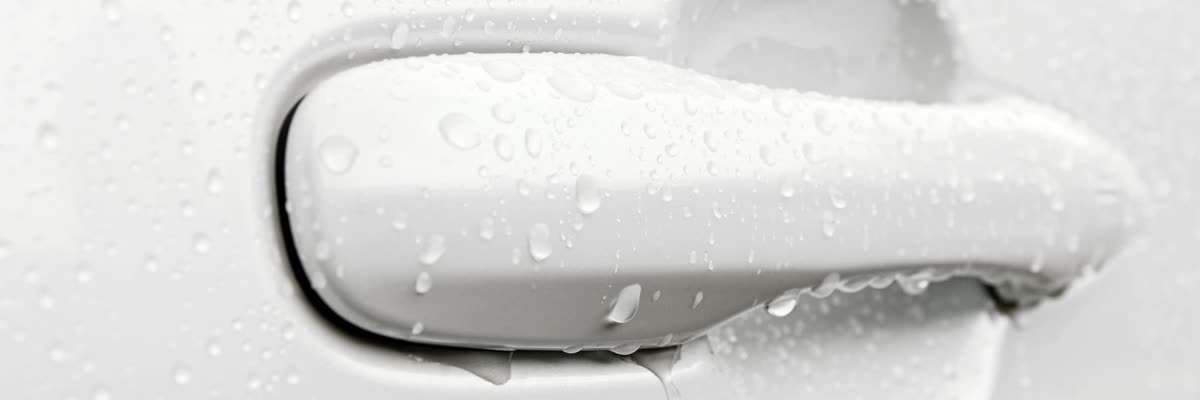
A ceramic coating is a liquid polymer that cures into a hard, optically clear layer bonded to your factory clear coat. It is about nine microns thick, roughly a tenth of a human hair. That is enough to change how the paint behaves, and nowhere near enough to do half of what it gets sold as.
What it actually does
- Water leaves on its own. Rain sheets off at speed and beads at rest, so the car stays cleaner between washes and dries without a towel dragging across the paint.
- Washing gets safer. Most swirl marks come from washing, not driving. Dirt that sits on a coating instead of keying into the clear coat comes off with far less pressure, which is where the long-term gloss is really won.
- Contamination struggles to bond. Bug residue, tree sap, road film and brake dust all sit on the surface rather than etching into it, provided they are removed within a sensible time rather than baked on for a month.
- Colour holds. The layer carries UV resistance, so reds and dark blues hold their depth for years longer than an uncoated panel parked outside.
What it does not do
- It does not stop scratches. Nine microns of polymer will not survive a stone at highway speed, a key, or a trolley in a car park. Anyone claiming scratch-proof is selling something.
- It does not replace washing. It makes washing easier and less risky. A coated car left dirty for a season looks like a dirty car and the coating takes the blame for it.
- It does not fix the paint underneath. A coating is clear and it locks in whatever it is applied over, swirls included, for years. That is why we correct first and why we will not skip it.
- It does not last forever unattended. Five years is with an annual inspection and a wash routine that does not include a brush tunnel. Without those, expect two.
What it costs
Coating price is set by panel area, so it is quoted by vehicle size rather than by a package name. These are the coating figures on a finish that is already corrected. If it is not, correction is quoted separately after we look at it.
Civic, Camry, 3 Series and anything of that footprint. Two full days plus an overnight cure.
RAV4, CR-V, Tucson, X3. More glass and a taller roof, which is more surface and more time on a ladder.
Highlander, Pilot, F-150, Sienna. Three days is normal on these rather than two.
Paint correction is not included and is quoted per car, from $450, after twenty minutes with the car under inspection light and a paint depth gauge. There is no charge for that inspection and no obligation after it. A correction booking holds the date with a deposit that comes off the final bill and is refundable up to 48 hours before.
What the three days are
The coating itself takes about an hour to apply. Everything else is what makes it last, which is why a coating quoted as a two-hour job is not the same service under the same name.
-
Inspection
45 to 60 minutes
Panel by panel under 5000K light at a raking angle, with a paint depth gauge on every panel, photographed before anything is touched. If the clear coat is too thin to correct safely, you find out here rather than after.
-
Decontamination
60 to 90 minutes
Iron remover for brake fallout, solvent for tar, then a clay bar over every painted surface. A coating applied over bonded contamination seals it in and fails early.
-
Correction
4 to 12 hours, quoted separately
A measured test spot first, to find the least aggressive combination that works, then panel by panel with a dual-action polisher. If the defects run deeper than the test spot predicted you get a call and a revised number, never an invoice that grew on its own.
-
Panel wipe
30 minutes
Every panel wiped down to strip polishing oils. Oils left behind flatter the finish and stop the coating bonding, which is a failure that only shows up months later.
-
Coating and cure
2 to 3 hours, plus overnight indoors
Applied by hand one panel at a time, levelled by eye under inspection light, then left to cure in a closed bay. Curing is chemistry and chemistry does not care about anyone's schedule, so we will not release a coated car early. Rain on an uncured coating undoes the whole job.
Keeping it, and what ends it
The warranty runs five years and covers gloss and water behaviour, not damage. If the coating stops beading and sheeting the way it did on collection, we strip it and reapply at no charge. If a stone chips the panel, if the car is resprayed, or if it goes through an automatic wash with spinning brushes, the warranty on that panel ends. We would rather write that down now than argue about it in year three.
For the first week, keep it dry where you reasonably can and do not wash it at all. The coating is hard to the touch on collection and still finishing its cure underneath.
After that, two buckets, a clean mitt, a pH-neutral shampoo, and a wash roughly every two weeks. No brush tunnel, ever. A touchless wash is survivable in February and is not a substitute the rest of the year.
The annual inspection is free and it keeps the warranty live. It takes about twenty minutes, we decontaminate anything that has bonded, and we remind you rather than waiting for you to forget.
- Who does the work
- The person who inspects your car is the person who coats it. No subcontracting.
- Where it cures
- Indoors and locked, overnight, every time. A coated car does not sit outside on our watch.
- What we photograph
- Every panel at inspection and again at collection. You get both sets whether you ask or not.
- What ends the warranty
- Brush tunnels, respray or body repair on a coated panel, polishing the coating off, or a missed annual inspection.
Questions people actually ask
Does a ceramic coating stop scratches?
No. A coating is roughly nine microns of hardened polymer. It resists the fine marring that washing causes, and it makes contamination easier to remove, but it will not stop a stone chip, a key, or a trolley. Anyone who tells you otherwise is selling something.
Do I still have to wash the car?
Yes, and washing it properly is what keeps the warranty live. A coating makes washing easier and less risky, not optional. Two buckets, a clean mitt, and no automatic wash with spinning brushes.
Can you coat a car that has not been corrected?
We will not. A coating is optically clear and seals in whatever is underneath it for years, swirls included. If the paint is already good, correction is short and cheap. If it is not, you should know that before you spend the money.
How long do I lose the car for?
Two to three days for a coating on a corrected finish, because the coating has to cure indoors overnight. Correction on top of that adds a day or more, and we tell you the number before you book, not after.
Is it worth it on an ordinary car?
Often yes, and not for the reason people expect. On a commuter car the value is in five years of easier washing and less risk of adding swirls every time you clean it. If you plan to sell within a year, a correction and a sealant is the better spend.
What voids the warranty?
An automatic wash with spinning brushes, a respray or body repair on a coated panel, polishing the coating off, or missing the free annual inspection. Stone chips and collision damage were never covered; the warranty is on gloss and water behaviour, not on damage.
Coating cars across Vaughan and York Region
The bay is in Vaughan, off Highway 7 near the 400, which puts Woodbridge, Maple, Concord and Kleinburg inside fifteen minutes and Richmond Hill, Thornhill and Markham inside half an hour. Most coating bookings come from those six.
We also take cars from Aurora, Newmarket and King City, and from north Toronto, Brampton and Mississauga. A coating means leaving the car for two or three days, so distance matters less than it would for a wash, but it is worth being honest that a car forty minutes away is a harder booking to reschedule if the weather turns during correction.
Winter is the busiest season for coatings here and the reason is road salt. A coating applied in October gives the paint a surface that brine struggles to key into, and it makes the February wash, the one nobody wants to do properly, far less likely to add swirls.
If you have just bought a used car in the GTA and want it sorted before the salt starts, book the inspection first. It is free, it takes twenty minutes, and it tells you whether you are buying a coating or a coating plus a day of correction before you commit to either.
Book a coating, or ask first
The booking form is on the main page and arrives with Ceramic Coating already selected. If you would rather just describe the car to someone, the phone is faster and you will not be put through a script.
Tuesday to Saturday, 8am to 6pm. If we are under a car we will miss it, so leave a message and you get one back the same day.